
Dover AFB, USDA turn lights out on Spotted Lanternfly
The Air Force selected the 436th Civil Engineer Squadron pest management section as the lead test hub for future Spotted Lanternfly mitigation practices for military aircraft.
The U.S. Department of Agriculture has described the Spotted Lanternfly as an invasive insect, native to Asia, that can cause damage to crops, ornamental trees, vineyards and forests, including its preferred host, the invasive tree of heaven, which is found in the local area.
Known as a “hitchhiker” type insect, the pest is believed to have possibly made its way to the U.S. in cargo containers aboard shipping vessels. They attach and lay eggs on objects which then causes disbursement around the world.
The 436th CES and the USDA Animal and Plant Health Inspection Service, Plant Protection and Quarantine, have partnered up to conduct testing on Spotted Lanternfly mitigation and present data to the Armed Forces Pest Management Board.
“We're the base that does the most aircraft disinsection and we usually benchmark anything that has to do with aircraft disinsection,” said Ken Barnes, 436th CES infrastructure superintendent. “So any questions that get asked about aircraft or what to do, they come to us.”
Three chemicals were tested, including 10% d-Phenothrin, Callington Aircraft Insecticide and Callington 1-Shot. Only the 10% d-Phenothrin is authorized to be used on military aircraft requiring insecticide application for Japanese beetles.


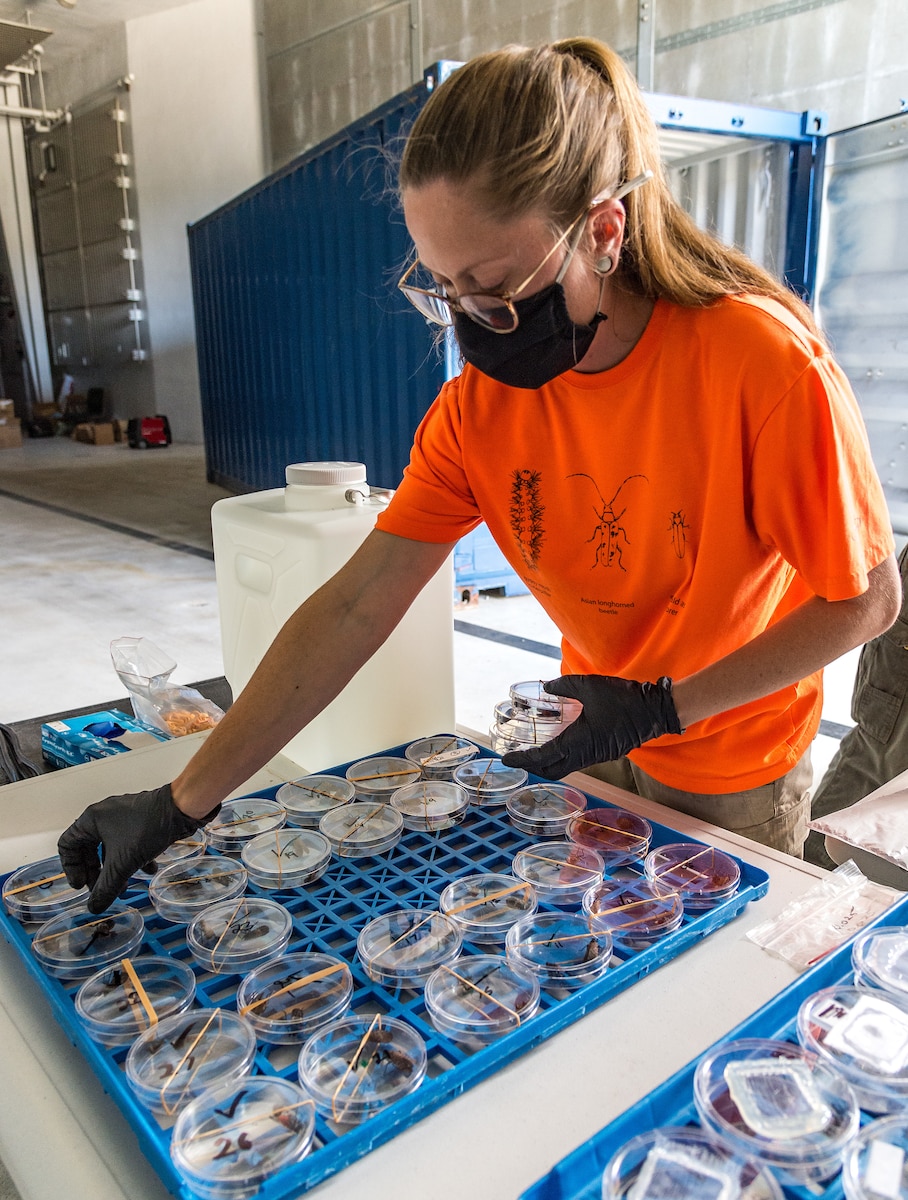
“The basis behind this test is to see which of the three chemicals [we have] will be authorized for aircraft disinsection,” Barnes said. “None of them are universally approved for [Spotted Lanternflies, Japanese beetles and Zika]. That’s driving what the USDA is doing here because the [Armed Forces Pest Management Board] wants to figure out, once the supply of 10% d-Phenothrin aerosol runs out, what are we going to use next?”
Currently, 436th CES pest management personnel spray 10% d-Phenothrin to disinsect aircraft for Japanese Beetles and mosquitoes possibly carrying the Zika virus, however, that product is no longer being produced.
At the moment, New Castle and Kent Counties in Delaware are under a Spotted Lanternfly quarantine, meaning numerous areas within those counties have been identified as having infestation. The insects used in tests conducted at Dover AFB were gathered by USDA personnel from a large population located in Wilmington, Delaware.
"We are looking for established populations around here. We don’t have any on base, but there are areas outside the perimeter of our base that have the tree of heaven." Ken Barnes
“The goal of the cooperative program at the USDA is mitigation at this point, more than eradication,” said Lianmarie Colon Torres, USDA plant health safeguard specialist. “There are strategies in terms of treatment and trapping that the USDA has been doing for a couple of years to contain populations outside of the quarantine areas.”
Three 1,200 cubic foot shipping containers were used to simulate an aircraft cargo area where six modified plastic food containers, each containing Spotted Lanternflies, were placed in each shipping container, then exposed to a specific insecticide prior to closing the door and left for 15 minutes. Mortality counts were taken at predetermined time intervals.
“It seems like the [insects] are very susceptible to most of the aerosols we’ve experimented with,” said Colon Torres. “We are seeing mortality in all of our experiments but the 1-Shot seems to have 50 to 60 percent mortality per experiment.”
According to Colon Torres, the 1-Shot is a mixture of d-Phenothrin and Permethrin.
The project leader for testing, Dr. Phil Lewis, USDA-PPQ, Forest Pest Method Lab, is working to recommend one product to the pest management board that can be used for disinsection on military aircraft.
“I think [Spotted Lanternflies] are a big issue and it’s going to be a big problem for years to come as it continues to spread,” Lewis said. “Usually new infestations of invasive pests are found by homeowners.”
The results of the testing provided to the pest management board will have an effect DoD-wide for pest mitigation practices.
“We are looking for established populations around here,” Barnes said. “We don’t have any on base, but there are areas outside the perimeter of our base that have the tree of heaven.”
For more information on the Spotted Lanternfly, visit the USDA website.
