AMC, AFMC commanders talk logistics on attack, integrated deterrence at warfare symposium
“Vast distances and few areas to use as supply nodes … all potentially during a period of competition.” That is how Royal Air Force Air Commodore Jez Attridge described the task at hand in the Pacific as moderator of a mobility panel discussion at the Air and Space Forces Association 2023 Warfare Symposium in Aurora, Colorado, March 7.
The panel, titled “Logistics on the Attack,” was a conversation about the buildup and sustainment of materiel necessary to “set the theater,” featuring Gen. Mike Minihan, commander of Air Mobility Command, and Gen. Duke Richardson, commander of Air Force Materiel Command — the two leaders with the most skin in the game for the successful delivery of logistics effects.
Richardson began by highlighting his charge to address integration across the logistics enterprise.
“Both the level of the threat we are facing and the idea of how we are going to answer it through a distributed laydown of forces really drives the need for integration,” he said.
Attridge punctuated this need, evoking the dramatic struggles of Russia’s military to deliver even with what he described as plenty of roads and relatively short distances. “[Putin] has shown us really well what it looks like when it goes wrong — when the build-up and delivery doesn’t account for ‘Plan A’ or ‘Plan B.’”
The challenge before the two major commands is how to prepare to operate in an environment exponentially more complex, across huge swathes of water and against the tyranny of vast distances. Integration, Minihan said, buys down risks across capability gaps and addresses the requirement to operate at speeds that outpace a potential adversary — what he called the “tempo required to win.”
“You cannot have integrated operations if you do not have integrated planning in advance,” Minihan said, describing the close relationship between AMC and AFMC.
What this looks like at the command level is intimate coordination and cross-talk in the form of staff-to-staff meetings, table-top exercises and other planning activities.
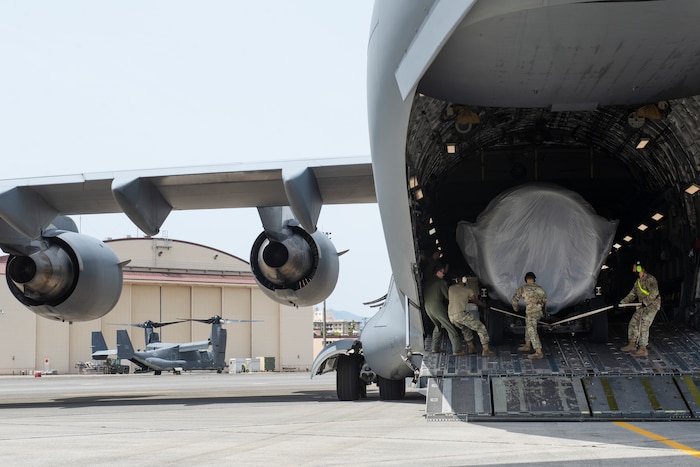
Building on Richardson’s explanation of AFMC’s data-driven approach to ensuring the appropriate materiel needed for the future, Minihan noted several major components that underpin success in the Pacific: the Global Air Mobility Support System, which is critical to the positioning of war reserve materiel and continued collaboration with allies and partners in the region. The projection of military power into a theater, he said, boils down to pallet-making and unit type codes, specialized kits of specific, itemized equipment.
The two commands have worked together in preparation for Mobility Guardian 2023, AMC’s largest exercise set to take place in the Pacific this summer, which will show in sharp definition the critical role of the mobility air forces in rapidly positioning and maneuvering the rest of the Joint Force. That exercise will realize many of the efforts between the two commands over the last year.
“When you are the joint force maneuver, when everybody is counting on you to be successful, when every capability the joint force enjoys needs to be in position to aggregate to be lethal, to disaggregate to survive, and then re-aggregate to be lethal again,” Minihan said. “That is exactly where this command’s focus is.”

Attridge summed up the strategic deterrence value of the conversation.
“It’s fair to say if the focus is ‘China, China, China,’ then in order to deliver credible conventional deterrence, you should be going to sleep at night thinking about ‘logistics, logistics, logistics.’”
Minihan completed the metaphor, describing how readiness is deterrence, such that “our adversaries wake up, open up the window, look at us and say, ‘I don’t want any piece of that.’” Adding, “but if they should decide to take us on, then we can win decisively for this nation.”
